
The common advice says your skin undertone decides everything. It does not. Your clothes usually make the louder statement, especially in summer. A bright orange dress, icy blue shirt, or lime-green tank can make the wrong metal look flat within seconds.
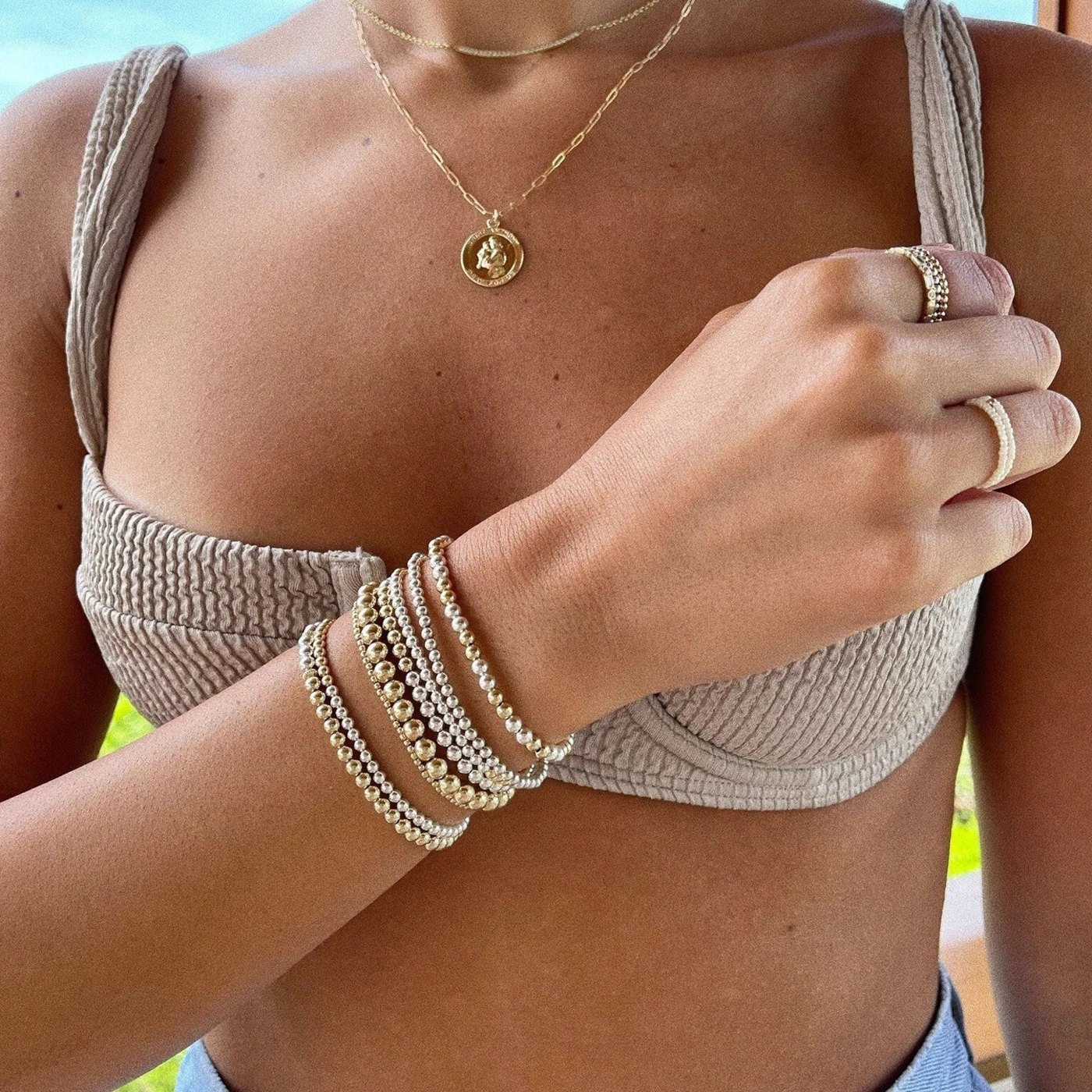
The useful question is simple: does the jewelry repeat the color’s temperature, sharpen it with contrast, or compete with it? For most summer outfits, gold wins with warm saturated colors, while silver looks cleaner beside cool, pale, or high-contrast shades. Here is the fast method.
Gold or Silver: Start With the Color, Not Your Skin
Gold and silver do not change your outfit in the same way. Gold adds yellow, warmth, and visual weight. Silver adds blue-white brightness and a sharper edge. That difference matters more than a warm-versus-cool label printed on a seasonal color chart.
| Summer clothing color | Best starting metal | Why it works | Best finish |
|---|---|---|---|
| Coral, tomato red, tangerine | Yellow gold | Repeats the warm red-orange family | Polished or softly brushed |
| Powder blue, cobalt, icy pink | Silver | Keeps the outfit crisp instead of adding yellow | High polish |
| Kelly green, lime, chartreuse | Yellow gold | Creates a lively warm contrast | Brushed or sculptural |
| White, black, navy | Silver or mixed metal | Sharp contrast gives the outfit structure | Clean geometric shapes |
That is the starting point, not a prison. A silver necklace can look excellent with coral if the outfit needs cooling. A gold ring can rescue a pale blue outfit that feels too cold. The strongest choice is the one that fixes the outfit’s problem.
The quick verdict
Choose gold when the clothing looks sunbaked, earthy, or spicy. Choose silver when the clothing looks watery, icy, or graphic. Choose mixed metals when the outfit already contains both warm and cool signals.
Why Summer Colors Change the Metal Decision
Summer colors tend to be brighter and more exposed than winter colors. You see more skin, more daylight, and more color near the face. That makes small differences in shine and temperature easier to notice. Jewelry is not only decoration here. It acts like a color filter around the neckline, ears, and hands.
Color temperature is the first filter
Warm colors contain more yellow, red, or orange. They include apricot, coral, marigold, tomato, camel, olive, and warm green. Gold sits naturally beside those shades because both reflect heat. The result looks deliberate instead of accidental.
Saturation decides how much metal you need
A highly saturated garment already has strong visual energy. Pairing it with a large, mirror-bright metal can create too much competition. Use one substantial gold piece with orange or emerald, not five equally loud pieces. Pale summer colors can handle more shine because they need contrast and definition.
Light changes the balance
Direct sunlight makes yellow gold look richer and silver look brighter. Under cool indoor lighting, silver may look almost blue while gold can look muted. Judge the full outfit in daylight before buying a metal for a single mirror selfie. The best summer jewelry remains readable in both conditions.
Finish matters more than metal when color is already loud. A brushed surface softens neon clothing. A polished surface sharpens white, navy, and cobalt. Shape matters too: rounded forms make hot colors friendlier, while straight lines make cool colors feel more modern.
How to Test Gold Versus Silver in Five Minutes
Stop guessing from wrist veins. Use the actual outfit and a controlled comparison.
- Put on the exact clothing color. Include the neckline, because a metal that works with a shirt may fail beside a dress or swimsuit.
- Remove competing accessories. Take off your watch, necklace, earrings, and hair clips. You need to compare one variable at a time.
- Hold gold beside the face. Use a hoop, chain, or even a clean fabric swatch. Look for clarity around the eyes and cheekbones, not whether the metal looks pretty by itself.
- Repeat with silver. Keep the distance and lighting the same. Take two photos: one in daylight and one indoors.
- Check the garment, not just your skin. If gold makes the fabric look muddy, silver is the better tool. If silver makes the outfit look hard or washed out, gold has the advantage.
- Pick the smallest useful piece. Test the winning metal as a stud or thin chain before buying a large cuff. A bad metal becomes much more obvious as its surface area grows.
Use the three-second rule
Look away, then look back at the outfit. The correct metal should register as part of the look, not as a separate object asking for attention.
Use the repeat test
Find one color already in the outfit and ask whether the metal supports it. Gold repeats warmth. Silver repeats cool brightness. If neither repeats anything, choose contrast on purpose and keep the jewelry simple.
Gold Wins With Warm Summer Colors
For coral, orange, tomato red, warm green, and cream, choose yellow gold first. It gives these colors a richer frame and makes simple summer clothing look finished without adding another competing hue.
Best gold shapes for bright clothing
Use rounded hoops, organic pendants, and medium-width chains. A very thin gold chain can disappear beside saturated fabric. A giant statement necklace can fight it. The sweet spot is one visible piece between 16 and 25 millimeters, plus smaller supporting jewelry.
The Mejuri Dôme Brioche Hoops are a practical example: 18k gold vermeil, 16.3 millimeters in diameter, 9.8 millimeters wide, and listed at $178 when checked for this 2026 guide. Their knotted shape has enough width for a coral or olive outfit without looking formal.
For a lower-cost, more irregular look, the Missoma Small Molten Hoop Earrings use 18k gold-plated vermeil and were listed at $122. The uneven surface catches sunlight better than a completely flat hoop.
When gold becomes too much
Do not add yellow gold to every warm color automatically. Mustard, rust, and camel can look heavy with a thick polished chain. Choose a brushed finish, smaller scale, or one silver accent to break the block of warmth. The verdict remains gold, but the quieter version wins.
Silver Wins With Cool Summer Colors
Does silver work with pale blue?
Yes. Silver is the cleanest choice for powder blue, icy pink, lavender, mint, and optic white. It keeps the palette light and gives pale clothing enough definition around the face. Choose polished silver when the outfit is crisp; choose a satin finish when it already has a lot of shine.
Is silver too cold for black and navy?
No. Black and navy benefit from silver because the contrast creates a clear outline. The Pandora Sparkling Round Halo Stud Earrings are sterling silver, measure about 8.9 by 8.3 millimeters, and were listed at $85. Their small scale works with a navy slip dress or black tank without turning the outfit into evening wear.
For a more sculptural option, the Tiffany & Co. Elsa Peretti Bean Earrings are sterling silver with a 9-millimeter motif and a listed price of $550. They make sense when the outfit is minimal and the jewelry must provide the shape.
When should you skip silver?
Skip silver when the outfit is already gray, dusty, or drained of contrast and your goal is warmth. Silver will reinforce that flatness. Use gold, rose gold, or a warm stone instead. Silver is the winner for cool color, not a universal rule for every pale outfit.
The Summer Jewelry Mistakes That Ruin a Good Outfit
Most metal mistakes are styling mistakes, not color-theory problems.
Mistake 1: Matching every item too literally
Gold earrings, gold necklace, gold sunglasses, gold buttons, and a gold bag chain can turn a lively summer outfit into one long metallic stripe. Stop after one main piece and one small echo. The clothing should still lead.
Mistake 2: Ignoring material quality
Gold vermeil is not solid gold, and sterling silver can tarnish. Sweat, sunscreen, salt water, and chlorine speed up wear. Remove plated jewelry before swimming, wipe it after humid days, and store it dry. Do not pay solid-gold prices for a thin flash coating.
Mistake 3: Choosing scale by trend alone
Large hoops can look excellent with a plain white tank but overwhelm a busy floral print. Tiny studs can disappear beside a saturated dress. Match jewelry size to the visual density of the clothing: simple outfit, larger piece; busy outfit, cleaner piece.
Mistake 4: Treating undertone as a rule
Your skin, hair, makeup, fabric, lighting, and metal finish all change the result. A person told to wear silver may look better in gold with a coral dress. The outfit test beats a fixed personal-color label every time.
How to Mix Gold and Silver Without Looking Random
Mixed metals work when one metal clearly leads. The mistake is giving gold and silver equal weight with no bridge between them. That looks accidental because the eye cannot tell which choice controls the outfit.
| Outfit situation | Dominant metal | Supporting metal | Simple ratio |
|---|---|---|---|
| Coral dress and tan sandals | Gold | Silver watch | Three gold pieces to one silver |
| White shirt and cobalt skirt | Silver | Gold ring | Three silver pieces to one gold |
| Black swimsuit and bright scarf | Either | The other metal as a bridge | Two visible pieces per metal |
Use one bridge piece
A two-tone watch, mixed-metal chain, or ring with both finishes tells the eye that the contrast is intentional. Put the bridge near the center of the look, such as on the wrist or middle finger. Then keep the earrings and necklace simpler.
Finish the outfit with the shoe and bag check
Look at hardware. Gold buckles, warm leather, and tan sandals support gold. Silver buckles, white sneakers, black leather, and cool gray bags support silver. You do not need perfect matching, but repeating one metal twice makes the final look feel controlled.
So, back to the bright summer outfit that started the problem: coral, orange, and warm green get gold first; powder blue, lavender, black, and optic white get silver first. Test the winning metal in daylight, keep one piece in charge, and let the color of the clothing—not an undertone rule—make the final decision.